Showing posts with label tours. Show all posts

Welcome to Hyper Morocco Tours

Hyper Morocco Tours is a local tour company based in the south of Morocco. We offer customized tours adapted to your choices, time frame, and budget.
Our professional  team is committed to provide quality service at competitive rates. We believe that in order to grow in our industry we must be unique. Therefore our goal is to provide the best services for our clients.
Hyper Morocco Tours will help you discover new destinations and find the ideal tour selection for solo travellers, couples, families, and friends.

Watch this Introduction video:


Our services:

  • Airport transfer upon your arrival to Marrakech, Fes, Casablanca, or Agadir.
  • Hotel bookings or suggestions adapted to your needs and budget.
  • Cultural tours to explore the history and traditions of Morocco (Imperial cities, old casbahs, Ksars)
  • Desert tours to admire the beauty of the golden desert dunes, and to experience the lifestyle of the real berber nomads.
  • And many other exciting activities: Camel trekking, desert camping (berber tents), hiking, cooking classes with locals.

Our Tours:
Take a look at our selection of tours and contact us for more details, we offer tours from:


Our Vihicules:
We provide very comfortable transportation with air conditioning, we mainly use minibuses and 4x4 land cruisers

Contact us:
We welcome your inquiries via our contact form or via our emails:
contact@hypermoroccotours.com
hypermoroccotours@gmail.com


Read what people said about us:


Thank you for your interest in our company!


Meski - The Blue Source - Errachidia


Meski - The Blue Source - Errachidia

One day Excursion or few days camping

Meski is a small town in the Province of Errachidia in the region Draa-Tafilalet of Morocco. It has fewer than 1,000 inhabitants. It was the location of a battle between French and Berber forces in the Zaian War on 15 January 1919 where General Joseph-François Poeymirau defeated Sidi Mhand n'Ifrutant.

 Here's a youtube video where you can see Meski pool from all angles and sides:

Short version:

Longer version:


2021 Version in 4k:

You can do a one day excursion to Meski from Errachidia, there are Big Taxis that would take you there from Errachidia's Taxi station, it costs 6 Moroccan Dirhams (about half a Euro)
There are also buses that go from Errachidia to Meski and back, it costs 3 moroccan dirhams.
if one day excursion is not enough for you then there's another option, you can camp there for few days, it costs 20Dh per person/night, which is roughly 2 euros..
the place is amazing, water and green nature all around you, you can swim in the pool at night when it's empty or in daylight under the sun and get a nice tan. there are shops there too. Camping starts there from spring but if you come in the summer (July - August) you will have a lot of company, many tourists and local come to camp in Meski for few days, it is magical to spend the nights under the stars hearing water and enjoying the cool breeze in hot weather.
So Brink your tent and coming camping in Meski, it's gonna be a great experience, afterwards you can continue your journey to the desert for some camel trekking in the Huge Sahara dessert dunes.

Tours from Marrakech

Tours from Marrakech


Those are the most popular tours that visitors usually book from Marrakech, but we can make a costumized one depending on your interests and time frame.
Contact us for more details: contact@hypermoroccotours.com
or via our Contact form


Watch this 3 days tour example in Video:

2 days 1 night:
Day 1 : Marrakech - Ait Ben Haddou - Draa Valley - Zagora
Day 2 : Zagora - Draa Valley - Ouarzazate - Marrakech

See Details
_________________________________________________________
 

3 days 2 night:
Day 1 : Marrakech - Ouarzazate - Rose Valley - Boumalne Dades
Day 2 : Boumalne Dades - Tinerhir - Erfoud - Rissani - Merzouga

Day 3 : Merzouga - Rissani - Daraa Valley - Ouarzazat - Marrakech

Or if you want the tour to end in Fes: 

Day 3 : Merzouga - Errachidia - Midelt - Azrou - Ifrane - Fes

_______________________________________________________
 

5 days 4 nights:
Day 1 : Marrakech - Ouarzazate - Skoura - Kelaa Mgouna
Day 2 : Kelaa Mgouna - Boumalne Dades - Tinerhir - Erfoud - Merzouga
Day 3 : Merzouga - Erg Chebbi - Merzouga
Day 4 : Merzouga - Alnif - Nkoub - Zagora
Day 5 : Zagora - Ouarzazate - Marrakech

Tours from Fes


Tours from Fes


Those are the popular tours that tourists usually book from Fes, but we can make a customized one depending on your interests and time frame.
Contact us for more details: contact@hypermoroccotours.com
or via our Contact form


This is an example of a 3 days tour starting from Marrakech and ending in Fes and that also can be done in the other way around (start from Fes and End in Marrakech)


3 days 2 nights: (Fes - Merzouga - Fes)
Day 1 : Fes - Ifran - Azrou - Midelt - Erfoud - Rissani - Merzouga
Day 2 : Merzouga - Erg Chebbi - Merzouga
Day 3 : Merzouga - Rissani - Erfoud - Errachidia - Fes


 _____________________________________________________ 

3 days 2 nights: (Fes - Merzouga - Marrakech)
Day 1 : Fes  - Ifrane - Azrou - Midelt - Erfoud - Rissani - Merzouga
Day 2 : Merzouga - Rissani - Tinerhir - Boumalne Dades
Day 3 : Boumalne Dades - kelaa Mgouna - Ouarzazate - Marrakech


_____________________________________________________

4 days 3 nights:
Day 1 : Fes - Ifrane - Azrou - Midelt - Erfoud - Rissani - Merzouga
Day 2 : Merzouga - Erg Chebbi - Merzouga
Day 3 : Merzouga - Rissani - Tinerghir - Boumalne Dades
Day 4 : Boumalne Dades - kelaa Mgouna - Ouarzazate - Marrakech
 

_____________________________________________________

7 days 6 night (Imperial tour):
Day 1 : Casablanca Arrival
Day 2 : Casablanca - Rabat - Meknes
Day 3 : Meknes -
Volubilis - Fes
Day 4 : Fes city tour
Day 5 : Fes - Beni Mallal - Marrakech
Day 6 : Marrakech city tour
Day 7 : Departure from Marrakesh or from Casablanca
 

_____________________________________________________

8 days 7 nights:
Day 1 :
Casablanca Arrival - Rabat - Volubilis - Fes
Day 2 : Fes city tour
Day 3 : Fes - Azrou - Ifrane - Midelt - Erfoud - Merzouga
Day 4 : Merzouga - Erg Chebbi - Merzouga
Day 5 : Merzouga - Rissani - Tinerhir - Boumalne Dades
Day 6 : Boumalne Dades - kelaa Mgouna - Ouarzazate - Marrakech
Day 7 : Marrakech city tour
Day 8 : Departure from Marrakesh (or from Casablanca)


 _____________________________________________________

Taghazout


Taghazout


Taghazout on youtube video:


Taghazout (in Amazigh "Berber": ⵜⴰⵖⴰⵣⵓⵜ, Taɣazut; Arabic: تاغازوت) is a small surfing and fishing village 19 km (12 mi) north of Agadir south west Morocco. The inhabitants speak mostly Berber but there are also few westerners living there. The main sources of income for taghazout inhabitants are Fishing, tourism, and the production of Argan oil. The developing tourism industry promises to increase the wealth of the region.
The common theme for visitors now is Surfing. Morocco is famous for its long right hand point breaks; thoroughly consistent and generally uncrowded. The most famous of which is a little to the north. In the right conditions this point can take you on a 2 km ride, starting at Anchor Point, joining up with Hash Point and ending on the beach break at Panorama's. It's called surfing from village to village. There are several other in and around the area making it an ideal destination for all levels of surfing skill. The waves work best between September to April especially for advanced surfers, receiving similar conditions to that of mainland Europe, but with the warm waters of the Moroccan Atlantic up to 21 degrees.The rest of the year, the surf is good for beginners and intermediate
There are several beaches north of Agadir, which all offer a good alternative to the local beach in town. The setting of these beaches can be most attractive, with mountains on all sides, yet with a wide and clean beach with all necessary amenities. The largest and popular are: Tamawanza (12 km), Aitswal Beach, Imouran (17 km),Taghazout beach (19 km), Du lkhmiss 20, Bouyirdn (21 km), Timzguida allal (22 km), Imiouadar (27 km), Aghroud (30 km)
Taghazout Bay

The site Taghazout-Argana Bay is 15 kilometres north of Agadir. It is intended to become the first seaside resort in Morocco, 300 km from Marrakesh, the first cultural and tourist centre of the country and 170 kilometres from the city of Essaouira.

Taghazout Bay is part of the Moroccan national tourism strategy ‘Vision 2020’. It is expected (September 2018) to provide the implementation of 8000 beds (5800 hotel), with a closer and more environmentally friendly tourism development, "Taghazout eco-resort." It further provides for a village of surfers, a village green holiday, camping with international standards, an 18-hole golf course, cafes, restaurants, shops and galleries.

Rabat


Rabat

Rabat (Arabic الرباط; Amazigh ⵕⴱⴰⵟ, transliterated ar-Rabāṭ or ar-Ribāṭ or (Er-)Rbāṭ, literally "Fortified Place"; French Ville de Rabat; Spanish Ciudad de Rabat), is the capital and third largest city of the Kingdom of Morocco with a population of approximately 650,000 (2010). It is also the capital of the Rabat-Salé-Zemmour-Zaer region.

Rabat on Video HD

The city is located on the Atlantic Ocean at the mouth of the river Bou Regreg. On the facing shore of the river lies Salé, the city's main commuter town. Together with Temara the cities account for a combined metropolitan population of 1.8 million. Silting problems have diminished the Rabat's role as a port; however, Rabat and Salé still maintain important textile, food processing and construction industries. In addition, tourism and the presence of all foreign embassies in Morocco serve to make Rabat one of the most important cities in the country.

Rabat is accessible by train through the ONCF system and by plane through the nearby Rabat-Salé Airport.


Rabat in the 50s in video:


More photos of Rabat:

Morocco: People and Culture


Morocco: People and Culture

Here is a brief description of the Moroccan ethnicities and backgrounds:
 
Moroccans were essentially Amazighs just like their neighbors: the Algerians and Libyans. Although, The population of Morocco is about 34 million. People from Morocco are called Moroccans.

many of the Moroccans have Arab, Spanish, black African, and Jewish ancestors. The official languages of Morocco are Arabic and Amazigh. French is also used, but only in big companies, universities, and in some TV channels. Morocco used to be occupied by France for 44 years. Some people in the north (close to Spain) speak Spanish as well. Spain also occupied parts of Morocco before leaving them in 1956 and in 1975. Most educated Moroccans do not speak English well, or do not know it at all. But since recent years, English is being taught to students in an increasing number of schools. Most Moroccans follow Islam as their religion. There are very small numbers of Christians, Jews, and non-believers.

Morocco: Origins


Morocco: Origins


“Morocco” in its various European forms is derived from the city of Marrakesh, which was built in the early eleventh century. The oldest surviving mention of it comes in an Italian document dated 1138.

“Marrakesh” is still used occasionally today, in informal Arabic, for the country as a whole, and Fez (Fas), the other great city, is the name modern Turks give to the state. In Arabic, the modern official language and that of most of its inhabitants, the country is called “Maghrib.” This is a confusing term since it is also used to describe the whole group of countries in north-western Africa (Morocco, Mauritania, Algeria, Tunisia and sometimes Libya). It means “the land of the setting sun,” the furthest westward point of the great Islamic empire founded by the Prophet Muhammad in the middle of the seventh century AD.

“Moors,” a rather outdated word now, and one with a distinct pejorative tinge, was popular in European languages in the late medieval and early modern periods. To eighteenth-century writers the Moors were the urban inhabitants of all north-western Africa, and sometimes all Muslims.

These were the traditional enemies of Christian Europe and, like Shakespeare’s Othello, most Moors were believed to be black. Finally, many inhabitants of Morocco are called “Berbers.” The term is largely a linguistic one, describing people who speak one of several dialects, spread over the whole of northern Africa, notably Morocco (forty per cent of the modern population) and Algeria (twenty per cent), with smaller groups in Tunisia, Libya and western Egypt. The Tuareg nomads of the Sahara also speak a Berber dialect, the one that is least contaminated by Arabic. The name itself is not, of course, a Berber word. It is a Graeco- Roman expression, referring to all those who did not speak Greek or Latin: they were barbari or “barbarians.” Applied to the people of northern Africa, it was popularised by the great fourteenth-century historian Ibn Khaldun. He used it as the title of his History of the Berbers and again in his great Introduction to History (the Muqadimma), which was one of the first attempts to explain the rise and fall of dynasties in theoretical terms.

The Berbers call themselves “Imazighen,” or something similar, depending on the dialect. It means “noble men” or “free men,” in the sense that they were free of external control, unlike the inhabitants of the towns, who belonged to no tribe. Those who could find no protection from kin were at the mercy of the powerful and were truly servile.

Basic informations about Morocco


 Basic informations about Morocco

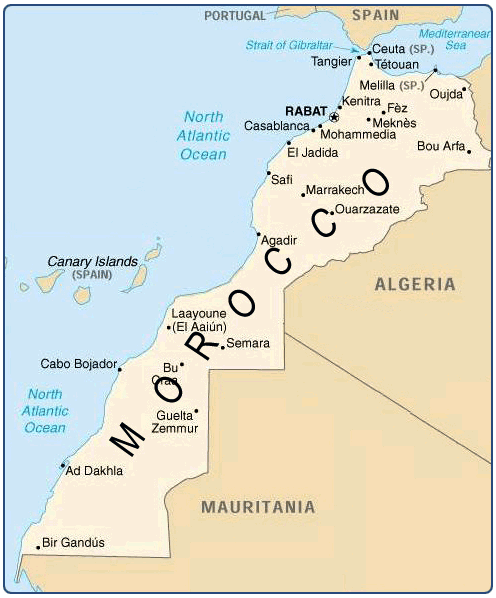
Morocco is not only a holiday destination for tours and excursions, apart from being a touristical attraction for its famous sand dunes desert, imperial cities, moutains and beaches, Morocco is also an old country that is very rich and diverse culturally.
So if you have a chance to visit Morocco make sure to have a taste of the real thing. 
Here is a short description so you can have an idea:

Morocco (Arabic: المغرب‎ al-Maghrib ; Amazigh: ⴰⵎⵕⵕⵓⴽ or ⵍⵎⴰⵖⵔⵉⴱ "Ameṛṛuk" or "Lmaɣrib"), officially the Kingdom of Morocco, is a country located in North Africa. It has a population of over 32 million and an area of 710,850 km² . Despite being situated in Africa, Morocco remains the only African state not to be a member of the African Union due to its unilateral withdrawal on November 12, 1984 over the admission of the so called (Sahrawi Arab Democratic Republic) in 1982 by the African Union as a full member without the organization of a referendum of self determination in the disputed territory of  Sahara.

Morocco is a constitutional monarchy with an elected parliament. The King of Morocco holds vast executive and legislative powers, including the power to dissolve the parliament. Executive power is exercised by the government but the king's decisions usually overwrite those of the government if there is a contradiction. Legislative power is vested in both the government and the two chambers of parliament, the Assembly of Representatives and the Assembly of Councillors. The king can also issue decrees called "dahirs" which have the force of law. The latest Parliamentary elections were held on November 25, 2011, and were considered by some neutral observers to be mostly free and fair. Voter turnout in these elections was estimated to be 43% of registered voters, but only about 25% of Moroccan adult citizens actually voted. The rest either chose not to vote or they were not registered as voters, thus not allowed to vote. The political capital of Morocco is Rabat, although the largest city is Casablanca; other major cities include Marrakesh, Tetouan, Tangier, Salé, Fes, Agadir, Meknes, Oujda, Kenitra, and Nador.

Almost all Moroccans speak either Amazigh or Moroccan Arabic as mother tongues. Hassaniya Arabic, sometimes considered as a variety of Moroccan Arabic, is spoken in the southern provinces  in the country by a small population.

source: Wikipedia

 
Contact informations: Hyper Morocco Tours

Smail Jarrou
Quartier Elmhamid 9
Marrakech 50000 Morocco
Email 1: contact@hypermoroccotours.com
Email 2: hypermoroccotours@gmail.com
Tel / Whatsapp: Soon